The Digital Trail: Everything You Need to Know About California DMV Data Sharing in 2026
5 months ago 2026-04-29 14:54The Digital Trail: Everything You Need to Know About California DMV Data Sharing in 2026
When you walk into a California DMV office to renew your license or register a vehicle, you are handing over some of your most sensitive personal information. But in 2026, the question on everyone’s mind is: where does that information go once the clerk hits “save”?
California DMV data sharing has become a focal point of legislative debate, privacy lawsuits, and consumer anxiety. From selling records to commercial entities to the controversial 2026 “Real ID” data migration, the landscape of your digital privacy is shifting rapidly.
What is California DMV Data Sharing and Why Does it Matter?
At its core, California DMV data sharing is the legal process by which the Department of Motor Vehicles provides driver and vehicle information to outside parties. While the DMV is a government agency, it operates as one of the state’s largest data repositories.
For decades, the DMV has shared data for “permissible uses” under the federal Driver’s Privacy Protection Act (DPPA). However, the scale and nature of this sharing have expanded. In 2026, the DMV isn’t just sharing names; it’s managing a complex web of data that includes Social Security placeholders, residential addresses, and even vehicle telematics for autonomous cars.
The 2026 Data Migration Controversy
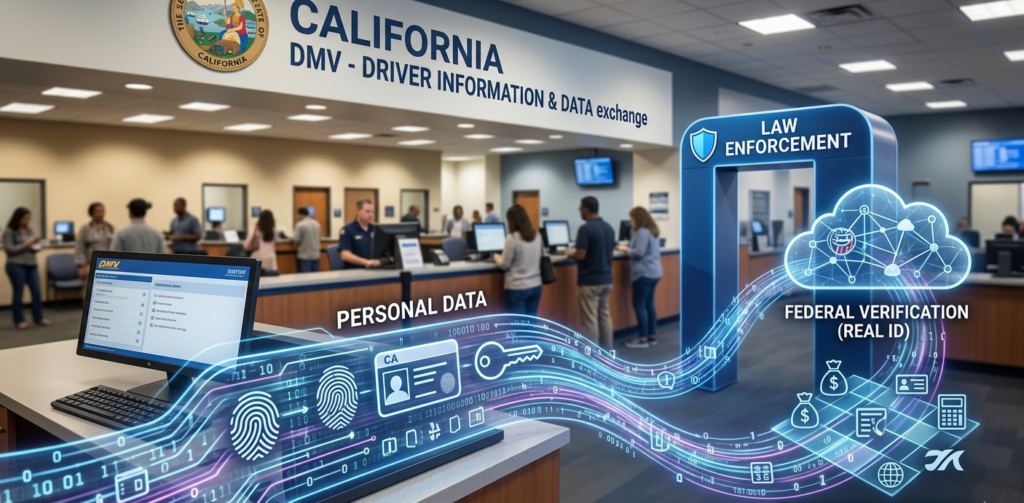
As of April 2026, California has begun sharing detailed driver information with a national verification system to comply with the Real ID Act. This move—costing the state roughly $55 million—allows the DMV to verify that residents do not hold duplicate licenses in other states.
Critics and advocacy groups have dubbed this a “betrayal,” as it involves sharing data points on over 1 million unauthorized immigrants who were previously promised confidentiality under AB 60.
Who Receives Your Information Through California DMV Data Sharing?
Your data doesn’t just sit in a vault in Sacramento. It flows through several “approved” channels, each with different levels of access.
1. Government and Law Enforcement Agencies
Law enforcement is the primary recipient of DMV data. Under California law, police can access driver records to investigate crimes, verify identities, and process traffic violations. In 2026, new regulations also allow the DMV to share safety metrics from autonomous vehicles directly with first responders.
2. Commercial Requesters and Data Brokers
The DMV has historically generated millions of dollars in revenue by selling data to commercial entities. These include:
- Insurance Companies: To verify driving records and set premiums.
- Banks and Lenders: To confirm collateral (vehicles) for loans.
- Background Check Services: For employment screening.
Important Note: In late 2025, Governor Newsom signed SB 361, which forces data brokers to disclose exactly what DMV-sourced information they hold, including your driver’s license number and Social Security digits.
3. The Employer Pull Notice (EPN) Program
If you drive for a living, your employer is likely part of the EPN program. Effective April 1, 2026, this program transitioned to a fully electronic system. It automatically notifies your employer if you get a speeding ticket, have a license suspension, or are involved in an accident.
How to Protect Your Privacy and Opt-Out
While some data sharing is mandatory for public safety or federal compliance, you do have rights under the California Consumer Privacy Act (CCPA) and the California Privacy Rights Act (CPRA), both of which saw significant updates on January 1, 2026.
Your Rights Under the 2026 Privacy Laws
- The Right to Know: You can request a “portable copy” of the data the DMV has shared about you.
- The Right to Correct: If your record shows an incorrect accident or violation, the DMV must provide a streamlined way to fix it.
- Sensitive Personal Information: Driver’s license numbers are now classified as “Sensitive Personal Information,” granting you higher protections against commercial sale.
How to Request Your Own Records
You can see exactly what the DMV is telling others by requesting your own INF 1125 (Driver Record) or INF 70 (Vehicle Record).
- Visit the official DMV portal.
- Pay the $5 fee.
- Receive a report detailing your public record history.
The Future of Data Privacy in California
As we move through 2026, the battle over California DMV data sharing is far from over. Lawmakers are currently debating bills that would force the DMV to notify owners when their data leads to a financial surplus (such as in lien sales) and tighten the “placeholder” system used for Social Security numbers to prevent the accidental flagging of immigrant populations.
The “New Style Guard” of privacy advocates is pushing for a “Consent-First” model, where the DMV would be prohibited from selling any data to third-party commercial brokers without an explicit opt-in.
Conclusion: Staying Informed in a Data-Driven World
The California DMV data sharing system is a double-edged sword. It provides the infrastructure needed for safe roads, insurance verification, and federal travel compliance, but it also creates a digital footprint that many feel is too large.
By staying informed on the latest 2026 regulations and utilizing your rights under the CCPA, you can take control of your information. Remember, your driver’s license is a tool for mobility—not a product for sale.
Are you concerned about how your data is being used? Regularly checking your driver record is the first step toward digital safety in the Golden State.
FAQ: California DMV Data Sharing at a Glance
Does the DMV sell my Social Security number?
No. Under state and federal law, Social Security numbers and residential addresses are considered confidential and are not shared for commercial marketing purposes.
Can I stop the DMV from sharing my data for Real ID?
Technically, no. If you wish to have a license that is compliant for domestic air travel, participation in the State-to-State (S2S) verification system is a federal requirement.
What is the “99999” placeholder?
It is a code used in the national data exchange for individuals who do not have a Social Security number. Privacy advocates worry this code uniquely identifies undocumented residents to federal authorities.