
The New 18U CubeSat Structure Frame by KSF Space: Ready for Your Space Mission
3 months ago 2026-06-09 14:57The New 18U CubeSat Structure Frame by KSF Space: Ready for Your Space Mission

The NewSpace era demands rapid deployment, high volumetric efficiency, and structural reliability. As satellite applications transition from simple technology demonstrations to dense orbital constellations, the requirement for robust, highly scalable hardware has never been more urgent. At the heart of this aerospace evolution is the cubesat structure—the physical backbone that determines whether a payload survives the violent mechanical loads of a rocket launch and the punishing thermal extremes of Low Earth Orbit (LEO).
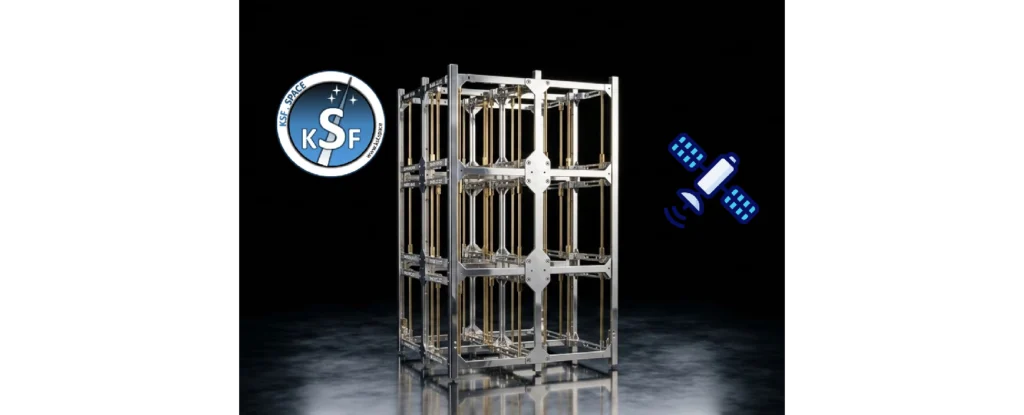
To meet the scaling demands of commercial Earth observation, tactical defense, and Internet of Things (IoT) global networks, KSF Space has introduced its newest heavy-duty platform: the 18U cubesat structure frame. Engineered for maximum payload capacity and flight-proven reliability, this innovative modular frame is completely ready for your space mission.
Whether you are a commercial satellite manufacturer assembling an IoT constellation, a defense contractor developing tactical micro-payloads, or an engineering firm deploying advanced remote sensing instruments, selecting the right cubesat structure is the most critical decision in your mission architecture. The KSF Space 18U chassis eliminates the compromise between custom payload volume and standardized deployer compatibility.
The Evolution of the Small Satellite: From 1U to the 18U Cubesat Structure
The small satellite revolution began with simple, highly standardized dimensions. The foundational unit of the industry, the 1U satellite frame, measures a compact $10 \times 10 \times 10\text{ cm}$. Over the past decade, as commercial demands expanded, this modular design scaled iteratively to form multiple form factors, including:
- 1U, 2U, and 3U frames: The traditional workhorses of academic research and biological testing.
- 6U and 12U frames: Highly capable configurations that introduced dedicated propulsion and early commercial imaging payloads.
- 18U and 24U structures: The modern high-capacity form factors engineered to bridge the operational gap between nanosatellites and larger microsatellites.
Why the Modern Space Industry is Scaling Up to 18U
While smaller form factors like the 1U, 2U, and 3U are perfect for validating single circuit boards or short-duration experiments, they present distinct limitations in surface area and raw volume. Advanced payloads—such as high-resolution optical apertures, multi-band synthetic aperture radar (SAR), and high-throughput telecommunication transponders—require significant physical real estate.
The 18U cubesat structure frame by KSF Space offers an optimized, high-volume architecture. This frame size provides the substantial internal volume needed for complex attitude determination and control systems (ADCS), deep-space chemical or electric propulsion, and extensive internal battery banks, while completely maintaining compliance with universal canisterized deployer standards.
Technical Specifications and Engineering Excellence of the KSF Space 18U Frame
A professional cubesat structure must act as far more than an empty metal box. It functions simultaneously as a structural shield, a precise thermal radiator, and an electromagnetic containment field. The KSF Space 18U frame is built upon a heritage of rigorous testing and precise material selection to guarantee absolute survival in orbital environments.
Premium Material Selection: Aerospace Aluminum
Every mission has unique mass, thermal, and shielding budgets. To address these distinct operational requirements, KSF Space provides high-grade material options for its satellite frames:
- Aerospace-Grade Aluminum (6061-T6 / 7075): This remains the gold standard for high-power, long-duration orbital missions. The aluminum cubesat frame acts as an expansive structural heat sink, drawing thermal energy away from high-duty-cycle transmitters and onboard processors. Additionally, it offers excellent baseline radiation shielding and a natural Faraday cage to protect internal electronics from electromagnetic interference (EMI).
Hard-Anodized Rails and Mitigating Cold Welding
In the deep vacuum of space, clean, bare metal surfaces can spontaneously fuse together upon physical contact—a catastrophic phenomenon known as “cold welding.” To eliminate this risk entirely, the aluminum outer rails of the KSF Space 18U cubesat structure undergo a precise hard-anodization process. This surface treatment guarantees smooth, ultra-low-friction deployment from the canister, ensuring that your satellite safely and reliably leaves the rocket deployer without snagging.
Meeting Rigorous Aerospace Test Standards: NASA GEVS Compliance
Every single cubesat structure manufactured by KSF Space is subjected to comprehensive, multi-layered environmental simulations to guarantee structural integrity before it ever arrives at the integration facility. The 18U frame is explicitly designed to meet the strict parameters of the NASA-GSFC-STD-7000 (General Environmental Verification Standard – GEVS).
Finite Element Analysis (FEA) and Structural Simulation
During the maximum dynamic pressure phase of a rocket launch (Max-Q), a satellite frame is subjected to intense random vibrations, acoustic loads, and mechanical shocks exceeding $10\text{ G}$. KSF Space utilizes advanced SOLIDWORKS Finite Element Analysis to model these exact stresses. The 18U frame is built with a strict structural safety factor of $1.25$ for yield loads and $1.4$ for ultimate loads, ensuring the chassis remains perfectly rigid, preserving internal electronics and delicate PCB stacks throughout the launch profile.
Vacuum Stability and Low Outgassing
In the vacuum of LEO, non-space-grade materials release volatile organic compounds that can condense onto optical elements, clouding camera lenses, degrading solar arrays, and shorting out electronics. The KSF Space 18U cubesat frame line uses materials thoroughly verified for low outgassing, maintaining a Total Mass Loss (TML) of well under $1.0\%$ and a Collected Volatile Condensable Material (CVCM) of less than $0.1\%$. This level of vacuum stability ensures that your high-resolution sensors and optical instruments remain pristine over multi-year operational timelines.
Tailored for Critical Satellite Applications: From IoT to Constellation Deployment
The massive volume of an 18U satellite frame unlocks structural capabilities that were historically restricted to expensive, custom-built microsatellites. This structural capacity makes it the ideal platform for a wide array of modern, high-revenue satellite applications.
1. Global IoT and M2M Satellite Networks
Internet of Things (IoT) and Machine-to-Machine (M2M) communication companies require large numbers of small satellites in LEO to ensure low-latency data relay across remote regions. The 18U cubesat structure allows constellation operators to integrate high-gain antenna arrays, complex software-defined radios (SDRs), and robust backup battery systems, enabling continuous, high-duty-cycle communication links without thermal bottlenecking.
2. Commercial Earth Observation and Remote Sensing
High-resolution imaging payloads require long focal lengths and rigid structures to ensure precise pointing accuracy. The 18U frame provides a stable, low-vibration platform capable of housing large optical lenses, multi-spectral imagers, or active radar electronics. By utilizing the KSF Space structure, imaging companies can achieve arcsecond-class pointing accuracy when paired with standard reaction wheels and star trackers.
3. Tactical Defense and Intelligence Missions
Modern defense frameworks rely heavily on rapid-response space capabilities. The 18U cubesat frame offers a discrete, modular form factor that can be rapidly integrated with secure tactical communication payloads, signals intelligence (SIGINT) receivers, or atmospheric monitoring equipment, providing flexible orbital configurations for national security assets.
Bespoke Aerospace Solutions: KSF Space Can Custom Design Your Own Satellite Structure
While off-the-shelf sizes ranging from 1U, 2U, 3U, 6U, 12U, 18U, to 24U fit standard launch integration profiles, KSF Space recognizes that specialized aerospace missions rarely adhere to a one-size-fits-all formula. Unique payloads frequently demand unorthodox mounting points, non-standard interior dimensions, specific optical cutouts, or hyper-specialized thermal trace pathways.
Bespoke Space Engineering: Beyond our standardized product lines, KSF Space can completely custom design your own satellite structure.
By working directly with our engineering team, mission managers can customize internal board spacing, design custom access hatches for late-load payload components, or engineer bespoke mixed-material frames optimized for extreme mechanical stress. This custom service significantly reduces development lead times, allowing your engineering team to focus entirely on core payload development rather than wrestling with mechanical integration constraints.
Why Choose KSF Space for Your Nanosatellite Infrastructure?
Selecting KSF Space as your hardware partner brings distinct engineering and operational advantages to your program:
- Extensive Flight References: These structures possess comprehensive flight heritage, having successfully validated their design across a wide variety of suborbital profiles, near-space environments, and orbital missions.
- Non-Profit Efficiency: As a dedicated US-registered non-profit organization, KSF Space prioritizes the global democratization of space and scientific progress over high corporate margins. This operational structure allows us to deliver professional, flight-proven hardware at highly competitive price points.
- Cleanroom Ready Delivery: All frames are delivered fully processed, cleaned, and meticulously prepared for immediate integration within your cleanroom facility, minimizing post-purchase assembly friction.
- End-to-End Integration Compatibility: Built in strict alignment with the standard Cal Poly CubeSat Design Specification (CDS), ensuring full mechanical compatibility with all major international launch providers and deployment canisters.
Get Flight Ready: Contact KSF Space Today
The success of your upcoming orbital deployment relies entirely on the mechanical foundation you select today. Do not allow structural limitations, unverified materials, or prohibitive vendor costs to stall your launch timeline. The new 18U cubesat structure frame from KSF Space stands ready to transform your complex payload concepts into an active orbital reality.
For a comprehensive technical quote, structural STEP files, FEA simulation data, or to discuss how our engineers can custom design your own satellite structure, please reach out directly to our aerospace integration team:
- Official Web Portal: www.ksf.space
- Direct Engineering Contact: [email protected]
Frequently Asked Questions (FAQ)
What are the precise dimensions and mass limits of the 18U cubesat structure?
An 18U cubesat structure typically scales within a standard configuration layout (often structured as a $3 \times 3 \times 2$ or $3 \times 6 \times 1$ unit matrix), totaling roughly $20 \times 30 \times 30\text{ cm}$ in external dimensions. The final mass limits depend directly on your selected launch provider’s deployer specifications, though the KSF Space 18U frame is heavily optimized to maximize internal payload capacity while keeping structural mass to an absolute minimum.
Can the 18U structure be deployed from standard rocket canister systems?
Yes. All KSF Space satellite frames, ranging from 1U up to the large 24U frames, are explicitly engineered to comply with the international CubeSat Design Specification (CDS). They feature standard dimensions and hard-anodized rails that are fully compatible with mainstream commercial deployment canisters utilized by launch providers like SpaceX, Rocket Lab, and India’s ISRO.
How does aluminum protect internal electronics?
CNC-machined Aluminum (6061-T6/7075) frames act as an expansive structural heat sink, drawing thermal energy away from high-duty-cycle transmitters and processors. Additionally, the metallic shell provides robust radiation shielding and acts as a natural Faraday cage to safeguard internal electronics from critical electromagnetic interference (EMI) in orbit.
How does KSF Space assist with custom structural requirements?
KSF Space can completely custom design your own satellite structure from scratch. If your payload requires custom mounting configurations, unique internal wall partitions, or non-standard viewport windows for optical sensors, you can submit your custom requirements and payload layout to [email protected]. Our engineering team will perform custom SOLIDWORKS FEA modeling to generate a personalized structural solution tailored exactly to your mission specs.
What environmental testing certifications do KSF Space structures possess?
Every cubesat frame configuration is verified through comprehensive simulation and physical qualification frameworks that track the NASA-GSFC-STD-7000 (GEVS) standard. This verification ensures full compliance with the rigorous random vibration, mechanical shock, and thermal vacuum outgassing constraints mandated by all major global launch integrators.