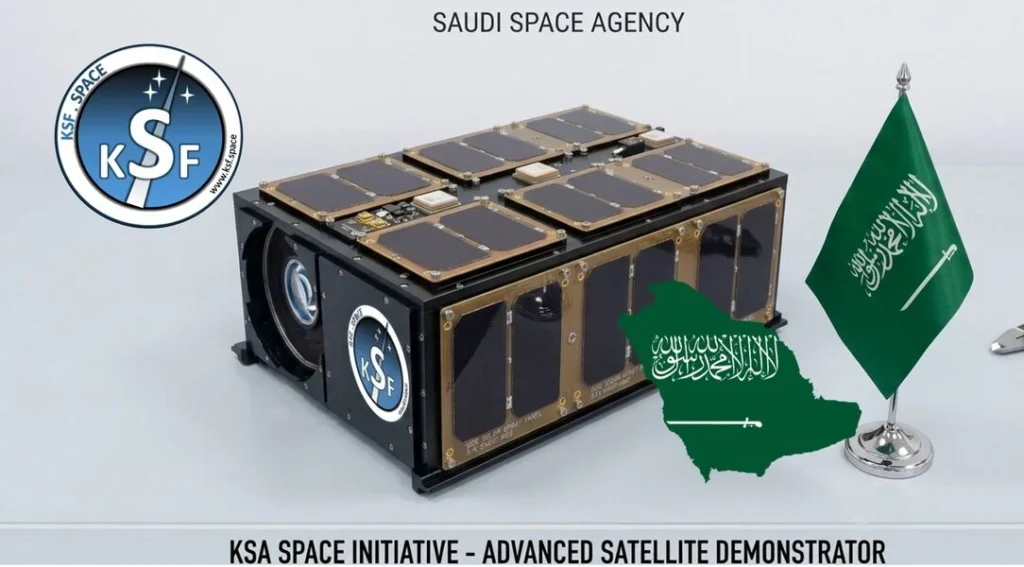
Driving the Saudi NewSpace Frontier: How KSF Space Empowers KSA Universities with Advanced CubeSat & STEM Programs
3 months ago 2026-07-09 16:16Driving the Saudi NewSpace Frontier: How KSF Space Empowers KSA Universities with Advanced CubeSat & STEM Programs
Driving the Saudi NewSpace Frontier: How KSF Space Empowers KSA Universities with Advanced CubeSat & STEM Programs
The global space industry is undergoing an unprecedented paradigm shift. The era of massive, multi-billion-dollar satellites monopolized exclusively by superpower governments has evolved into the “NewSpace” revolution. Today, compact, agile, and modular nanosatellites are defining the future of orbital research, global telecommunications, and climate monitoring. Under the visionary framework of Saudi Vision 2030, the Kingdom of Saudi Arabia is aggressively positioning itself as a dominant regional and global aerospace hub. Central to this ambition is the Saudi Space Agency, which is actively cultivating local talent to spearhead national aerospace initiatives.
For academic institutions across the Kingdom, the mandate is clear: to establish autonomous, high-powered aerospace engineering programs capable of feeding skilled professionals directly into the domestic space economy. This is where KSF Space steps in. As a premier global leader in space education and mission technology, KSF Space is dedicated to transforming any forward-thinking KSA University and Saudi University into an active launchpad for orbital discovery. By offering advanced engineering frameworks, flight-ready hardware, and specialized curriculum integration, KSF Space stands ready to develop cutting-edge STEM projects that allow students to design, assemble, and launch structures ranging from 1U, 2U, 3U, 6U, 12U, up to massive 24U configurations.
Why CubeSat KSA Initiatives Are Crucial for Saudi Vision 2030
The development of a dedicated Cubesat KSA infrastructure acts as a massive force multiplier for a knowledge-based economy. Miniaturized space technology offers a highly accessible, cost-effective pathway for a Saudi University to design, build, test, and safely deploy actual orbital hardware without the astronomical cost barriers historically associated with traditional space missions.
The Modular Evolution: Scaling from 1U to 24U
A standard CubeSat is built upon a compact, modular form factor of 10cm × 10cm × 10cm, mathematically designated as a single unit ($1\text{U}$). This elegant, standardized design allows systems to scale up seamlessly. Depending on the complexity of the scientific payload, sensors, or imaging equipment, a KSA University can scale these structures into $2\text{U}$, $3\text{U}$, $6\text{U}$, $12\text{U}$, or state-of-the-art $24\text{U}$ deep-space platforms.
By integrating Commercial Off-The-Shelf (COTS) components inside an aerospace-grade chassis, a Cubesat Saudi Arabia project bridges the gap between theoretical classroom mechanics and true orbital flight operations. Engineering students gain direct experience with:
- On-Board Computing (OBC): Developing low-power, fault-tolerant firmware to manage system data, storage, and commands.
- Electrical Power Systems (EPS): Designing advanced solar cell matrices and calculating precise battery deployment cycles under intense thermal fluctuations.
- Telemetry, Tracking, and Command (TT&C): Programming radio frequency transceivers to establish secure communication loops with localized ground stations.
KSF Space: Driving STEM and CubeSat Excellence for Professional University Education
Academic institutions cannot afford to rely on purely theoretical textbooks when the industrial demand requires immediate, practical technical competency. KSF Space is globally recognized for leading STEM and CubeSat initiatives engineered specifically for professional university education, technical colleges, and research institutions.
Unmatched Credibility Across All Sectors
Operating with rigid compliance and unparalleled expertise, KSF Space provides certified credibility to all sectors related to space education, satellite testing, and comprehensive mission technology. The organization serves as the definitive bridge between academic curiosity and orbital reality. When a KSA University collaborates with KSF Space, they are not simply acquiring hardware; they are securing an institutional partnership backed by international aerospace standards.
From structural integrity verification via Finite Element Analysis (FEA) to simulated environmental readiness inside thermal vacuum chambers, KSF Space ensures that every Nanosatellite KSA project is fully space-qualified and ready to interface with international launch vehicles.
The NEP Certification: Preparing the Next Generation of Saudi Aerospace Engineers
To maximize the impact of a Nanosatellite Saudi Arabia project, academic institutions must equip their faculty and students with standardized industrial skillsets. This is achieved through the Nanosatellite Engineering Professional (NEP) courses provided by KSF Space.
The NEP curriculum is an intensive, masterfully designed professional track that guides participants smoothly from basic structural design up to complex orbital operations and systems integration. By embedding NEP courses directly into an engineering department, universities instantly elevate their academic prestige and actively bridge the industrial skills gap.
| Module Track | Core Educational Objectives | Industrial Application |
| Mission Analysis & Orbitics | Keplerian elements, orbit selection, link budget calculations | Mission planning for the Saudi Space Agency |
| Subsystem Engineering | OBC architecture, EPS interfacing, transceiver tuning | Hardware-in-the-loop (HITL) system integration |
| Space Environment Survival | Thermal vacuum testing, radiation mitigation, resonance analysis | Space-qualification and mission assurance compliance |
How KSF Space Supports STEM Projects with KSA Universities
The roadmap to building a sovereign space capability within a university requires a structured, multi-phase engineering approach. KSF Space has streamlined this path, providing an end-to-end support system that guides academic departments from their initial concept to the ultimate launch countdown.
Flight-Ready Hardware and Advanced CubeSat Kits
KSF Space provides universities with access to industry-grade, highly reliable CubeSat kits. These kits serve as an incredible pedagogical tool, allowing students to physically handle, wire, configure, and program a functional small satellite structure. Whether an institution is planning an entry-level $1\text{U}$ weather-monitoring satellite or a massive, multi-instrumented $24\text{U}$ Earth observation platform, KSF Space delivers custom-tailored solutions designed to survive the hostile environment of Low Earth Orbit (LEO).
Secure Your University’s Position in the NewSpace Economy
The global space economy is moving at exponential speeds. The academic institutions that choose to establish their nanosatellite programs today will be the ones securing major research grants, pioneering proprietary payloads, and forming elite partnerships with the Saudi Space Agency tomorrow.
KSF Space is fully prepared and highly willing to deploy its technical expertise, flight hardware, and certified NEP training programs to any university or professional college across the Kingdom of Saudi Arabia. Let’s collaborate to build the future of Saudi aerospace from the ground up.
- Official Global Portal: KSF Space
- Academic & Mission Coordination: [email protected]
Frequently Asked Questions (FAQ)
What makes the KSF Space program uniquely suited for a Saudi University?
KSF Space combines academic excellence with industrial mission credibility. Instead of treating space engineering as an abstract science, KSF Space provides actual flight-ready hardware (from $1\text{U}$ to $24\text{U}$) alongside the globally recognized Nanosatellite Engineering Professional (NEP) curriculum. This ensures that university research directly aligns with the operational requirements of national entities like the Saudi Space Agency.
Can an undergraduate student handle a Cubesat Saudi Arabia development project?
Yes. While a basic background in STEM fields (such as electrical engineering, mechanical engineering, computer science, or physics) is highly beneficial, the NEP training modules provided by KSF Space are structured to build foundational skills incrementally. The curriculum expertly guides students from elementary structural concepts to advanced payload integration, making it ideal for undergraduate capstone projects and graduate research alike.
Are KSF Space CubeSat structures compliant with international launch standards?
Absolutely. Every single nanosatellite frame and component provided by KSF Space is meticulously engineered to comply precisely with the standardized CubeSat Design Specification (CDS). This complete compliance ensures seamless integration into major commercial deployers and launch vehicles worldwide.
How does a university initiate a CubeSat partnership with KSF Space?
Institutions can reach out directly via the dedicated academic email address at [email protected]. The engineering and education outreach teams at KSF Space will collaborate with your university faculty to outline a custom mission profile, select the appropriate configuration ($1\text{U}$ to $24\text{U}$), and integrate the NEP course tracks directly into your engineering department’s curriculum.