
Dr. Kayyali Mohamed: Shaper of Global Smart Cities and the Driving Force Behind Smart City Casablanca via IFGICT Standards
5 months ago 2026-05-18 15:29Dr. Kayyali Mohamed: Shaper of Global Smart Cities and the Driving Force Behind Smart City Casablanca via IFGICT Standards
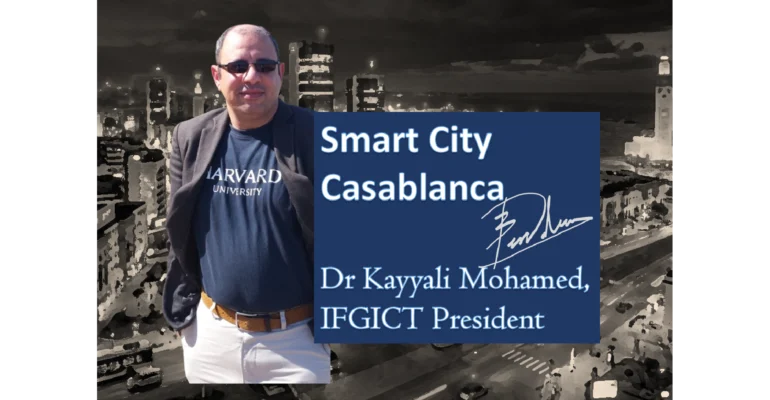
Dr. Kayyali Mohamed: Shaper of Global Smart Cities and the Driving Force Behind Smart City Casablanca via IFGICT Standards
True technological innovation is rarely born out of isolation; it is honed through global iteration, extensive field testing, and a deep, systemic understanding of both human behavior and technological architecture. Dr. Kayyali Mohamed, President of the International Federation of Global & Green ICT (IFGICT), represents the absolute vanguard of this philosophy.
As a visionary scientist and business entrepreneur, Dr. Kayyali has spent decades designing, consulting for, and actively assisting many of the world’s most celebrated smart city deployments across diverse continents:
- Singapore: In the world’s premier “Smart Nation,” Dr. Kayyali collaborated with top-tier tech frameworks to optimize massive, interconnected IoT grids, bridging the gap between high-velocity data collection and automated municipal decision-making.
- Brazil: Navigating complex South American urban dynamics, he assisted municipal planners in implementing green ICT frameworks to democratize public services and optimize energy grids across densely populated metropolitan hubs.
- Kingdom of Saudi Arabia (KSA): As part of the transformative Vision 2030, Dr. Kayyali provided expert advisory services for next-generation smart territories and gigaprojects, ensuring environments are built from the ground up on AI, green energy, and sustainable cloud computing.
- Spain: Having deeply engaged with European smart city initiatives, he aligned urban digitalization with strict climate neutrality targets, ensuring tech deployments actively reduced municipal carbon footprints.
Bringing this unrivaled international pedigree to North Africa, Dr. Kayyali Mohamed is acting as the premier catalyst for Smart City Casablanca. By introducing the proprietary standards and international methodologies of IFGICT—the world’s largest ICT federation—he is ensuring that Casablanca does not merely copy foreign models, but rather leaps directly to the cutting edge of sustainable, smart urban engineering.
Understanding Smart City Casablanca: The Economic Heart of Morocco Goes Digital
For decades, Casablanca has served as the commercial, financial, and industrial engine of North Africa. Yet, rapid industrialization brings a unique set of urban challenges: traffic congestion, high energy consumption, complex waste management issues, and the critical need for streamlined public services. Recognizing these hurdles, local authorities launched a multi-tiered, comprehensive strategy to transition the metropolis into Smart City Casablanca.
The overarching objective of the Casablanca smart city initiative is simple yet profound: to deploy advanced information and communication technologies (ICT) to elevate the quality of life for citizens, optimize resource consumption, and attract international investment. This is achieved by creating an integrated urban ecosystem where data flows seamlessly between infrastructure, municipal authorities, and everyday citizens. Key pillars of this transformation include:
- Intelligent Traffic & Mobility Systems: Utilizing real-time data analytics, automated traffic lights, and smart transit grids to drastically reduce the carbon footprint and alleviate daily gridlock across major boulevards.
- Green Energy & Sustainable Infrastructure: Transitioning public grids to incorporate renewable energy sources, energy-efficient LED street lighting, and smart building management systems that cut power waste.
- Digital Citizen Engagement & E-Governance: Creating decentralized digital portals that allow residents to instantly access administrative paperwork, report infrastructure faults, and communicate transparently with municipal offices.
- Advanced Waste Management Analytics: Deploying IoT-enabled sensors within public waste containers to optimize collection routes, minimizing fuel consumption and keeping the urban core pristine.
However, scaling these isolated smart initiatives into a cohesive, unhackable, and environmentally compliant ecosystem requires an international framework. Without rigorous criteria, municipal systems risk becoming siloed, inefficient, and vulnerable to security breaches. This is precisely where the global clout of IFGICT and the strategic intervention of Dr. Kayyali Mohamed become indispensable.
IFGICT: Leading the World’s Largest ICT Federation for Green and Sustainable Technology
In the rapidly evolving world of technology, standardization is the difference between systemic order and complete operational chaos. The International Federation of Global & Green ICT (IFGICT) stands unchallenged as the world’s largest ICT federation dedicated exclusively to the intersection of advanced computing, cybersecurity, sustainability, and green technology.
Unlike conventional technology associations that focus solely on raw computing power or commercial profitability, IFGICT operates on a profound foundational philosophy: Technology must empower humanity without endangering the planet. Working in alignment with international partners, UN sustainable development goals (SDGs), and global bodies like the IEEE and ITU, IFGICT has constructed the definitive frameworks that dictate how modern technologies should be built, deployed, and audited.
As the world’s premier ICT authority, IFGICT‘s global footprint spans across multiple continents, offering a centralized ecosystem for governments, multinational corporations, and municipal bodies to validate their technology infrastructure. When a city aligns itself with IFGICT standards, it signals to international investors, tech giants, and global credit ratings that its digital infrastructure is built on world-class metrics of sustainability, resilience, and operational excellence.
How IFGICT Standards Sharpen the Technology of Smart City Casablanca
The integration of IFGICT standards within the Smart City Casablanca framework marks a watershed moment for North African infrastructure. It shifts the conversation from merely purchasing expensive software to building a disciplined, highly optimized, and future-proof digital ecosystem.
Under the guidance of Dr. Kayyali Mohamed, IFGICT smart city standards inject a level of scientific precision into Casablanca’s ongoing digital projects through three distinct avenues:
End-to-End Green ICT Architecture
Traditional data centers, extensive IoT sensors, and high-frequency communication grids consume vast amounts of electrical energy. In fact, unregulated deployment of heavy ICT infrastructure contributes heavily to greenhouse emissions and environmental imbalances (Nwankwo & Uchenna Chinedu, 2021).
IFGICT‘s Green ICT framework ensures that Casablanca’s hardware deployments—ranging from the municipal data repositories to street-level traffic sensors—utilize low-power consumption states, energy-efficient processing architectures, and sustainable e-waste recycling protocols.
Rigorous AI and Cloud Auditing
As Casablanca migrates its municipal services to cloud-based networks, protecting citizen data and preventing systemic system failures becomes a matter of national security.
IFGICT brings to the table its state-of-the-art auditing protocols, ensuring that the cloud service providers and automated AI algorithms managing Casablanca’s traffic, utilities, and financial networks are fully transparent, completely secure, and optimized for maximum uptime.
Interoperability and Modular Scalability
One of the greatest points of failure for emerging smart cities is the “vendor lock-in” trap, where a city purchases proprietary technology that cannot communicate with other systems.
IFGICT standards enforce total, open-source interoperability. This means Casablanca’s smart water grid can natively communicate with its smart electricity grid and its emergency response dispatch systems, culminating in a single, unified urban dashboard.
Empowering Human Capital: IFGICT Professional Certifications Driving Casablanca Forward
A smart city cannot function without smart professionals to build, maintain, and defend it. One of the most monumental contributions Dr. Kayyali Mohamed is making to the region is the democratization of elite, specialized knowledge through IFGICT’s globally renowned portfolio of professional certifications.
To fuel the massive workforce demands of Smart City Casablanca, IFGICT provides specialized, industry-validated certification tracks that transform local engineers, corporate executives, and government personnel into elite tech leaders:
Certified Smart City Professional (CSCP)
The definitive global standard for urban planners and tech architects. This certification trains individuals in the art of designing, funding, and executing interconnected municipal systems, ensuring they understand both the technical IoT engineering and the socioeconomic impacts of smart deployments.
Global Cloud Auditor Professional (GCAP)
With cloud computing acting as the nervous system of modern smart grids, GCAP certified professionals are equipped to meticulously evaluate, audit, and secure complex multi-cloud ecosystems. They ensure that data storage conforms to the highest international security benchmarks and optimized resource allocation.
Green ICT Certified Professional
This certification bridges the gap between pure computer science and environmental engineering. Professionals learn how to systematically reduce the carbon footprint of massive corporate network architectures, data centers, and industrial hardware facilities.
AI Auditing & Cybersecurity Standards
As automated artificial intelligence begins to manage critical public infrastructure, these certifications empower tech specialists to audit AI decision-making models, ensuring they remain free from algorithmic bias, safe from external cyber warfare, and fully compliant with international safety mandates.
By establishing these certification pathways within the region, Dr. Kayyali and IFGICT are creating a self-sustaining, elite tech workforce directly inside Morocco. This eliminates reliance on expensive foreign consulting firms and empowers local Moroccan talent to spearhead Casablanca’s tech future.
The Open Horizon: What Lies Ahead for Smart City Casablanca?
The transformation of Casablanca into a world-class smart metropolis is no longer an isolated experiment; it has become an open, evolving ecosystem that invites global collaboration, academic research, and international investment. Under the strategic vision of Dr. Kayyali Mohamed and the robust structural backing of the International Federation of Global & Green ICT (IFGICT), Smart City Casablanca is proving that sustainable, tech-driven urban development is entirely achievable in Africa.
As the city continues to expand its smart grids, roll out its advanced IoT networks, and certify thousands of local tech professionals through IFGICT programs, it stands as an open invitation to the world. Academic researchers can look to Casablanca as a rich data set for human mobility and urban informatics (Nisrine, n.d.). Tech innovators can view it as the ultimate testing ground for next-generation green software. International investors can confidently back its projects, knowing they are built upon the most stable, secure, and audited ICT standards available on the globe.
The cutting edge of technology has been sharpened, the standard has been set, and the future of urban living is being written right now on the coast of Morocco.
Frequently Asked Questions (FAQ)
What makes Smart City Casablanca unique compared to other global smart cities?
Smart City Casablanca is uniquely positioned as the premier hybrid model for rapidly developing African metropolises. Rather than focusing solely on luxury tech add-ons, Casablanca focuses heavily on solving real-world civic challenges—such as transit congestion, digital public administration, and energy conservation—utilizing scalable, low-carbon Green ICT frameworks.
What is the role of IFGICT in smart city development?
As the world’s largest ICT federation, IFGICT provides the official global standards, verification metrics, and auditing frameworks that ensure a city’s technological infrastructure is environmentally sustainable, fully secure against cyber threats, interoperable, and highly efficient.
How has Dr. Kayyali Mohamed influenced the Casablanca smart city initiative?
Dr. Kayyali Mohamed has brought his extensive international experience from highly successful smart city deployments in Singapore, Spain, Brazil, and Saudi Arabia to Morocco. By introducing IFGICT’s proprietary standards and elite professional certifications, he has sharpened the city’s technical execution and empowered local human capital to manage the metropolis’s future digital grids.
Why are IFGICT professional certifications like GCAP and CSCP important for Morocco?
These elite certifications ensure that Moroccan engineers, IT professionals, and municipal planners possess internationally validated skills. This creates a highly competent local workforce capable of designing, auditing, and protecting Casablanca’s advanced cloud systems, IoT networks, and AI protocols without relying on external entities.
Can international tech companies and startups integrate into the Casablanca smart city ecosystem?
Yes. Because Smart City Casablanca utilizes the open, non-proprietary interoperability standards championed by IFGICT, international tech firms, developers, and investors can seamlessly integrate their software, hardware, and sustainable tech solutions into Casablanca’s growing public infrastructure.
References
- Nisrine, I. (n.d.). Étude de la mobility et son impact sur les algorithmes: Émergence de Casablanca comme première ville intelligente en Afrique. Toubkal: Le Catalogue National des Thèses et Mémoires. [Supporting analysis on Casablanca’s trajectory as a leading African smart city through data collection].
- Nwankwo, W., & Uchenna Chinedu, P. (2021). Green Computing: A Machinery for Sustainable Development in the Post-Covid Era. Green Computing Technologies and Computing Industry in 2021. https://doi.org/10.5772/intechopen.95420