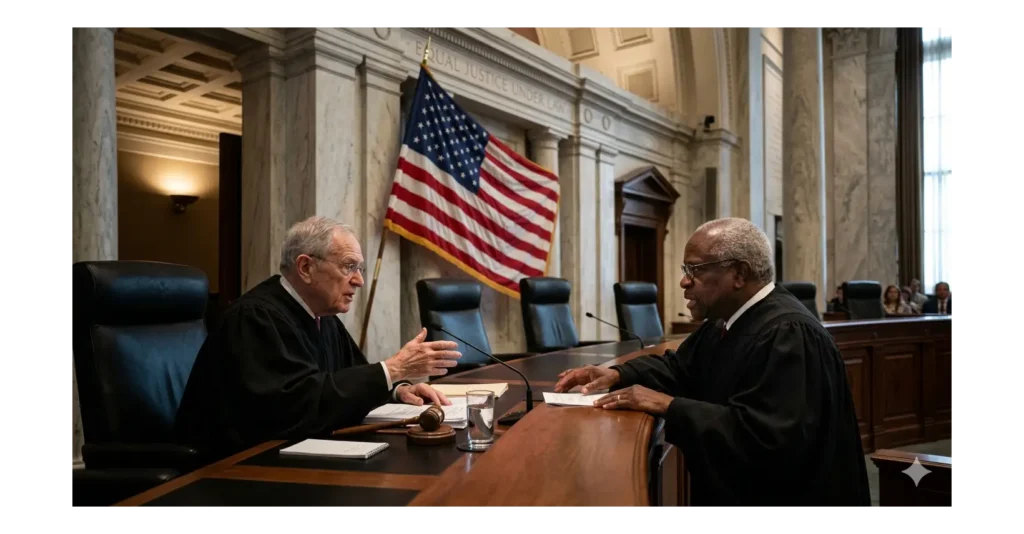
Alito Sotomayor Courtroom Disagreement: A Deep Dive into Judicial Philosophy
3 months ago 2026-06-26 12:43Alito Sotomayor Courtroom Disagreement: A Deep Dive into Judicial Philosophy
The inner workings of the United States Supreme Court are often shielded by a veil of tradition and formality. However, when the Justices take their seats, the ideological divide—and the intellectual tension—frequently bubbles to the surface. Among the most closely watched dynamics in the contemporary Court is the persistent alito sotomayor courtroom disagreement.
Representing the conservative and liberal wings of the judiciary respectively, Justice Samuel Alito and Justice Sonia Sotomayor often find themselves on opposing sides of landmark constitutional questions. Their exchanges, whether written in scathing dissents or voiced during intense oral arguments, offer a masterclass in contrasting judicial philosophies.
The Roots of the Alito-Sotomayor Divide
To understand the alito sotomayor courtroom disagreement, one must look beyond individual personalities and toward the fundamental differences in how each Justice approaches the law.
Formalism vs. Living Constitution
Justice Alito is a prominent proponent of judicial restraint and textualism. His opinions are often characterized by a rigorous adherence to the “ordinary meaning” of words at the time they were enacted. He frequently emphasizes that it is the role of the judiciary to interpret the law as written, leaving policy-making to elected legislatures.
Conversely, Justice Sotomayor often champions a more contextualized approach. Her jurisprudence is frequently informed by a concern for the real-world impact of legal decisions. In her view, the law does not exist in a vacuum; it must be understood in the context of history, societal power structures, and the lived experiences of those whom the law affects.
The Role of Context in Statutory Interpretation
A recurring theme in their disputes is the interpretation of statutory language. As seen in recent cases involving immigration and the definition of “arrival” at the U.S. border, the alito sotomayor courtroom disagreement often centers on whether a single word—such as “in”—should be read in isolation or within the broader purpose of the statute.
Case Study: The 2026 Border and Immigration Rulings
In June 2026, the Supreme Court issued rulings in cases such as Mullin v. Al Otro Lado, which highlighted these ideological differences with striking clarity.
The Majority View: A Plain-Meaning Approach
In Mullin, Justice Alito, writing for the majority, argued that the phrase “arrives in the United States” requires physical crossing. His reasoning was straightforward: in common parlance, one does not “arrive in” a location until they have entered it. For Alito, the judicial function here was to respect the precise language chosen by Congress, avoiding the temptation to expand the law’s reach beyond its literal text.
The Dissent: A Human-Centric Perspective
Justice Sotomayor’s dissent was sharp and impassioned. She argued that the Court’s “illogical interpretation” was driven by a hyper-fixation on a single preposition, ignoring the entire framework of the Immigration and Nationality Act. She emphasized that reading statutes in context is essential to prevent the law from becoming a tool that strips away humanitarian protections meant to save lives.
This disagreement serves as a perfect microcosm of why the alito sotomayor courtroom disagreement is so significant: it is not just a fight over a definition; it is a fight over whether the law should prioritize rigid linguistic structure or the humanitarian intent of the legislature.
Why Their Disagreements Matter
The public and legal scholars track the alito sotomayor courtroom disagreement because it serves as a barometer for the Court’s direction.
- Shaping Future Precedents: Every time these two Justices clash, they create a roadmap for future litigation. Their written opinions provide the primary arguments that lawyers on either side of an issue will use for decades to come.
- Defining the Court’s Legitimacy: Some argue that the intensity of these disagreements highlights the polarization of the nation, while others contend that this is exactly how a healthy constitutional democracy should work—with rigorous, transparent debate among its highest jurists.
- Influence on Legal Scholarship: Law students and practitioners analyze their exchanges to understand the shifting boundaries of Constitutional and Administrative law.
The Human Element: Beyond the Bench
While the media often portrays the alito sotomayor courtroom disagreement as a personal rivalry, it is crucial to recognize that these justices maintain the decorum expected of their office. Reports of their interactions during oral arguments—sometimes characterized by sharp questions aimed at the same attorneys—suggest that while they may fundamentally disagree on the law, they share a common arena of intense intellectual battle.
Whether it is a question of jury selection, civil rights, or the executive branch’s authority, when Sotomayor pushes back against an Alito-authored opinion, she is signaling that the legal debate is far from settled.
Conclusion: A Necessary Tension?
The alito sotomayor courtroom disagreement is more than just a clash of two powerful legal minds; it is a fundamental debate about the nature of American justice. Whether one aligns with the textual precision of Justice Alito or the contextual empathy of Justice Sotomayor, it is undeniable that the interplay between these two Justices is a driving force in modern American jurisprudence. As the Court continues to navigate complex issues in an evolving society, the echoes of their debates will undoubtedly continue to define the law of the land.