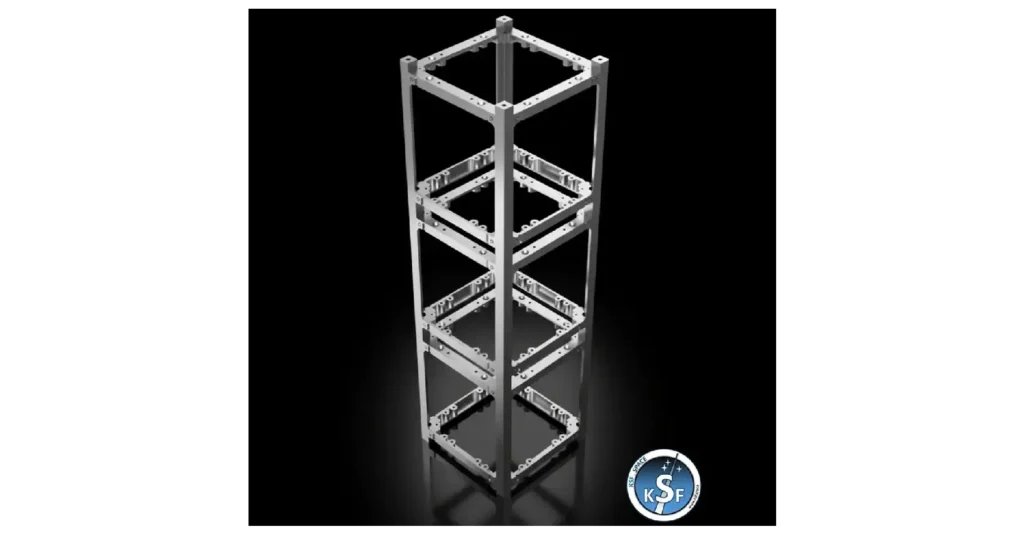
The Ultimate 3U CubeSat Frame Chassis Structure: Affordable, Flight-Proven Excellence by KSF Space
3 months ago 2026-07-02 11:00The Ultimate 3U CubeSat Frame Chassis Structure: Affordable, Flight-Proven Excellence by KSF Space
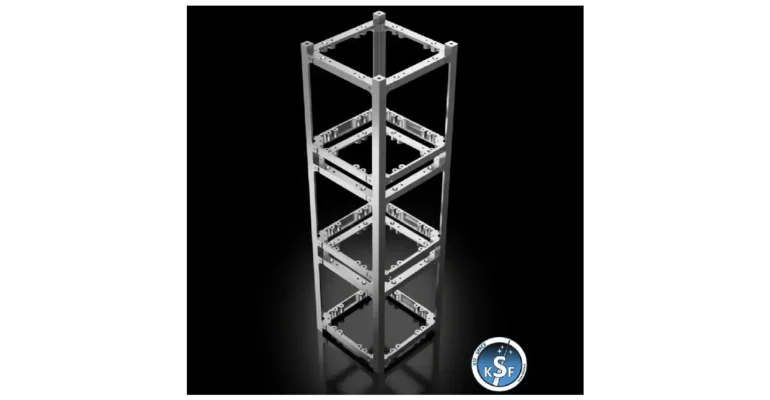
The Ultimate 3U CubeSat Frame Chassis Structure: Affordable, Flight-Proven Excellence by KSF Space
Building a satellite used to be a luxury reserved exclusively for billionaire corporations and national military budgets. In the modern NewSpace economy, the barrier to entry has officially fractured. However, standard satellite builders still face a massive bottleneck: the astronomical cost of structural hardware. For a satellite to survive, it requires a rigid, high-performance foundation that can withstand the violent mechanical vibrations of a rocket launch and the intense thermal extremes of Low Earth Orbit (LEO).
Enter KSF Space. As a premier US-registered non-profit organization dedicated to democratizing space access, KSF Space has engineered the world’s most affordable 3u cubesat frame chassis structure. This flight-proven platform allows universities, independent researchers, and commercial startups to shift their capital away from overpriced structural metal boxes and directly into their primary payloads.
Whether you are designing a single technology demonstrator or scaling a massive IoT constellation, choosing the correct Frame is the single most critical hardware decision in your mission’s lifecycle. Here is why the KSF Space 3U structure has become the global benchmark for modern orbital missions.
The Critical Role of a 3U CubeSat Frame Chassis Structure in Space Missions
A satellite structure is significantly more than an aesthetic outer shell; it is the literal mechanical backbone of your entire spacecraft. From the moment the rocket engines ignite at the launchpad to the final deployment stage in deep space, your 3u cubesat frame chassis structure performs several high-stakes engineering functions simultaneously.
Survivability Under Extreme Mechanical Launch Loads
During the maximum dynamic pressure phase of a launch (known as Max-Q), the satellite experiences extreme axial and transverse G-forces. A sub-par chassis will buckle, warp, or flex under these intense acoustic and random vibration environments, destroying delicate internal printed circuit boards (PCBs). The KSF Space 3u frame is engineered to survive $10\text{G}+$ RMS vibration profiles with a strict 1.4 Factor of Safety for ultimate loads.
Advanced Passive Thermal Management
In the vacuum of space, traditional thermal convection does not exist; heat can only be dissipated via conduction or radiation. An integrated aluminum cubesat structure from KSF Space acts as a high-conductivity heat sink. It draws thermal energy away from high-duty-cycle components—such as the On-Board Computer (OBC) and radio transmitters—and channels it evenly to the outer rails to be radiated into deep space.
Superior Electromagnetic Interference (EMI) Shielding
The space environment is flooded with solar radiation and high-energy cosmic particles capable of inducing single-event upsets (bit-flips) in unshielded flight computers. A precision-machined metallic cubesat frame acts as a natural Faraday cage, minimizing internal EMI and safeguarding your system’s data integrity throughout the mission lifetime.
Engineering Specifications of the KSF Space 3U CubeSat Structure
The KSF Space 3u cubesat frame chassis structure is meticulously designed to comply fully with the official Cal Poly CubeSat Design Specification (CDS). This complete structural compliance guarantees that your satellite will slide flawlessly into standard rail-based deployers, such as the P-POD, Nanoracks, or Exolaunch canisters.
| Technical Parameter | Precision Specification Value |
| Standard Form Factor | 3u Configuration (Linear Stack) |
| Exact Physical Envelope | $100 \times 100 \times 340.5 \text{ mm}$ (CDS Standard) |
| Structural Mass (Aluminum) | $\approx 350\text{ grams}$ (Optimized Strength-to-Weight) |
| Structural Mass (PA11 Polymer) | $\approx 210\text{ grams}$ (Ultra-Lightweight Option) |
| Internal PC Board Standard | Full PC/104 Standard Mounting Stack Compatible |
| Operational Thermal Range | Fully Verified from $-40^\circ\text{C}$ to $+85^\circ\text{C}$ |
| Testing Compliance Framework | NASA-GSFC-STD-7000 (GEVS Compliant) |
Beyond raw specifications, the KSF Space design utilizes an intuitive “Rapid-Integration” philosophy. Equipped with detachable modular shear panels, 3U CubeSat Frame Chassis Structure engineers can seamlessly assemble, adjust, and probe internal electronics without dismantling the primary load-bearing skeleton.
Why KSF Space Offers the World’s Most Affordable Chassis Options
The global space hardware market has long been artificially inflated by exorbitant corporate markups. KSF Space deliberately broke this paradigm by structuring its organization as a non-profit foundation. Because their core directive is global educational advancement and the democratization of aerospace engineering, they offer “at-cost” or highly subsidized pricing models for their structural line.
By refining global supply chains and employing advanced automated CNC milling along with industrial Multi Jet Fusion (MJF) additive manufacturing, KSF Space has minimized production waste. Satellite builders no longer have to sacrifice financial resources to gain a flight-qualified asset; KSF Space provides high-tier structural kits at a fraction of the cost requested by traditional commercial aerospace vendors.
Material Innovation: High-Grade Aluminum vs. Advanced PA11 Polymer
Different missions demand different structural properties. To satisfy this reality, KSF Space provides an innovative dual-track material offering for their 1u, 2, and 3u frameworks.
1. Aerospace-Grade Aluminum (6061-T6 / 7075)
Aluminum remains the undisputed gold standard for complex orbital configurations. It provides the highest absolute structural rigidity, which is vital for maintaining pointing accuracy during high-resolution Earth Observation or laser communication missions.
Crucially, all aluminum rails provided by KSF Space undergo a specialized hard-anodization surface treatment. This step is mandated by launch providers to completely eliminate the risk of “cold-welding”—a vacuum phenomenon where raw, touching metal surfaces permanently fuse together inside the deployer, preventing your satellite from ever launching into space.
2. Advanced PA11 Polymer (Polyamide 11)
For educational groups or teams navigating tight mass restrictions, KSF Space offers bio-sourced PA11 polymer structures processed via industrial MJF powder-fusion. This engineering choice provides a striking 40% mass reduction compared to aluminum, saving immense launch capital since payloads are priced strictly by the gram.
Furthermore, KSF Space’s proprietary “Black Smooth” vapor-honed finish seals the polymer surface entirely. This ensures strict vacuum stability 3U CubeSat Frame Chassis Structure , guaranteeing a Total Mass Loss (TML) of less than $1.0\%$, preventing outgassing molecules from forming film layers over your expensive optical sensors or camera lenses.
Scalability from 1U to 24U: The Power of a Customize Structure
While the 3U configuration serves as the ultimate industrial workhorse due to its optimized balance of volume and available solar array surface area, space exploration is never one-size-fits-all. KSF Space supports satellite builders across the complete spectrum of modular nanosatellite architectures, providing specialized platforms including:
- 1u & 2 Frames: Perfect for rapid technology demonstrations, biological studies, and introductory student programs.
- 6U & 12 Structures: Stepping into complex commercial territory, accommodating advanced liquid or electric propulsion units and wide-aperture imaging payloads.
- 16 & 24u Variants: Designed for high-end constellation applications requiring large internal battery capacities and deep-space communication configurations.
The KSF Space Customize Structure Advantage
If your mission requires non-standard physical dimensions, unique camera ports, specific antenna deployment windows, or custom internal mounting points, KSF Space offers a tailored customize structure service. Their engineering team can execute precise custom CNC milling or altered polymer geometries directly from your team’s STEP files, minimizing lead times down to weeks rather than the industry-average months.
Extensive Flight References and Suborbital Heritage
Never purchase an unverified satellite structure. In the aerospace sector, “Flight Heritage” is the premier metric used by insurers and launch integration managers to evaluate risk. KSF Space structures possess extensive flight references built across a diverse array of near-space and suborbital environments.
Through strategic worldwide partnerships, KSF Space has verified its nanosatellite structure frame components across three comprehensive test methodologies:
- JUPITER 1 Suborbital Rocket: Subjecting the cubesat frame to aggressive supersonic ascent forces, simulating absolute maximum vibration and structural stress environments.
- Supersonic UAV Flights: Reaching speeds of Mach 1.1 and altitudes up to 80 km to analyze intense atmospheric transit profiles and rapid structural thermal gradients.
- High-Altitude Space Balloons: Providing prolonged exposure (several hours) to stratospheric vacuum conditions and extreme cosmic radiation, confirming zero material outgassing and verifying thermal stability.
This multi-tiered testing history means that when you purchase a Professional Flight Model from KSF Space, you are receiving a structural system already optimized to clear the strict safety reviews of leading launch vehicles, including the SpaceX Falcon 9, Rocket Lab Electron, and ISRO PSLV.
Step-by-Step Satellite Integration Guide with a KSF Space Chassis
Integrating a spacecraft using the KSF Space 3u cubesat frame chassis structure is intuitive, thanks to its standardized modularity. Below is the technical roadmap to taking your satellite from a workbench prototype to a flight-qualified asset:
Step 1: Internal Component Stacking
Assemble your internal subsystems—including the Electrical Power System (EPS), battery banks, On-Board Computer, and transceivers—using standard PC/104 separation standoffs. Ensure all inter-board connectors are fully seated and torque-locked.
Step 2: Main Chassis Integration
Slide your completed electronics stack directly into the main KSF Space frame rails. The precision alignment tabs ensure that the internal boards are isolated from external mechanical shearing stresses.
Step 3: Harness Routing & Shear Panel Attachment
Route your internal RF cables and solar panel wires through the internal wiring channels. Fasten the external modular shear panels onto the primary Frame. Ensure that the dual redundant mechanical kill switches (located safely on the outer guidance rails) depress perfectly to isolate your electrical system during storage inside the deployer.
Step 4: Environmental Verification Testing
Subject your fully integrated 3U satellite to rigid Environmental Verification Testing (EVT). Run random vibration sweeps to identify structural resonances and execute Thermal Vacuum (TVAC) cycles to confirm your structural thermal dissipation pathways operate with an adequate safety margin.
Conclusion: Ready Your Next Space Mission with KSF Space
The foundation of your orbital legacy starts with your structural selection. Do not jeopardize years of engineering design on overpriced, unverified, or heavy structural frames. The hard-anodized aluminum and advanced polymer 3u cubesat frame chassis structure options from KSF Space provide the absolute pinnacle of global affordability, structural durability, and flight heritage.
By eliminating massive corporate financial barriers, KSF Space enables your team to launch faster, build smarter, and allocate capital where it matters most: your data and your payload.
Are you ready to clear the launchpad? Secure your flight-ready structural kit or request a personalized, high-precision customize structure blueprint by visiting the official engineers’ portal at www.ksf.space today.
Frequently Asked Questions (FAQ)
What makes the KSF Space 3U cubesat structure the most affordable option globally?
KSF Space operates strictly as a US-registered non-profit organization. Their core mandate is the global democratization of space technology rather than maximizing shareholder capital. By providing hardware at-cost, optimized through advanced manufacturing processes, they pass direct savings onto satellite builders.
Can the 3U cubesat frame chassis structure be fully customized?
Yes. Through their comprehensive customize structure service, KSF Space can easily mill custom optical apertures, unique antenna mounting brackets, specialized sensor ports, or unique internal card slots. Builders simply submit their custom STEP files to receive custom-machined structures.
Is the PA11 polymer structure safe for true orbital missions?
Absolutely. When processed via industrial Multi Jet Fusion and treated with the premium “Black Smooth” vapor-honed finish, PA11 polymer structures fully satisfy NASA and ESA strict low-outgassing requirements, maintaining a Total Mass Loss (TML) of well under $1.0\%$. This makes them incredibly safe for LEO deployments while saving up to 40% in structural mass.
What launch vehicles are compatible with KSF Space hardware?
Every 1u, 2, 3u, 6U, and larger chassis from KSF Space is completely “launcher agnostic.” Because they adhere strictly to the universal Cal Poly CubeSat Design Specification (CDS), they are certified for flight on SpaceX Falcon 9, Rocket Lab Electron, ISRO PSLV, and various European launch vehicles.
What is the standard manufacturing lead time for a KSF Space frame?
While traditional commercial aerospace vendors regularly cite lead times stretching from 3 to 6 months, KSF Space typically ships out standard structural configurations within 4 to 6 weeks for machined aluminum models, and as fast as 1 to 2 weeks for polymer structures.
References and Technical Resources
- The CubeSat Design Specification (CDS): California Polytechnic State University (Cal Poly). The foundational engineering guide establishing universal rail, dimension, and mass tolerances for modern nanosatellites.
- NASA State of the Art Small Spacecraft Technology Report: NASA Ames Research Center. Annual technical publication highlighting structural innovations, material outgassing metrics, and satellite deployment safety standards.
- NASA-GSFC-STD-7000 (General Environmental Verification Standard / GEVS): NASA Goddard Space Flight Center. The core framework defining proper payload vibration, acoustic, and thermal vacuum qualification parameters.
- KSF Space Mission Testing Archives: KSF Space Official Documentation. Technical flight reference records logs validating material structural durability across suborbital rocket, UAV, and stratospheric balloon missions.